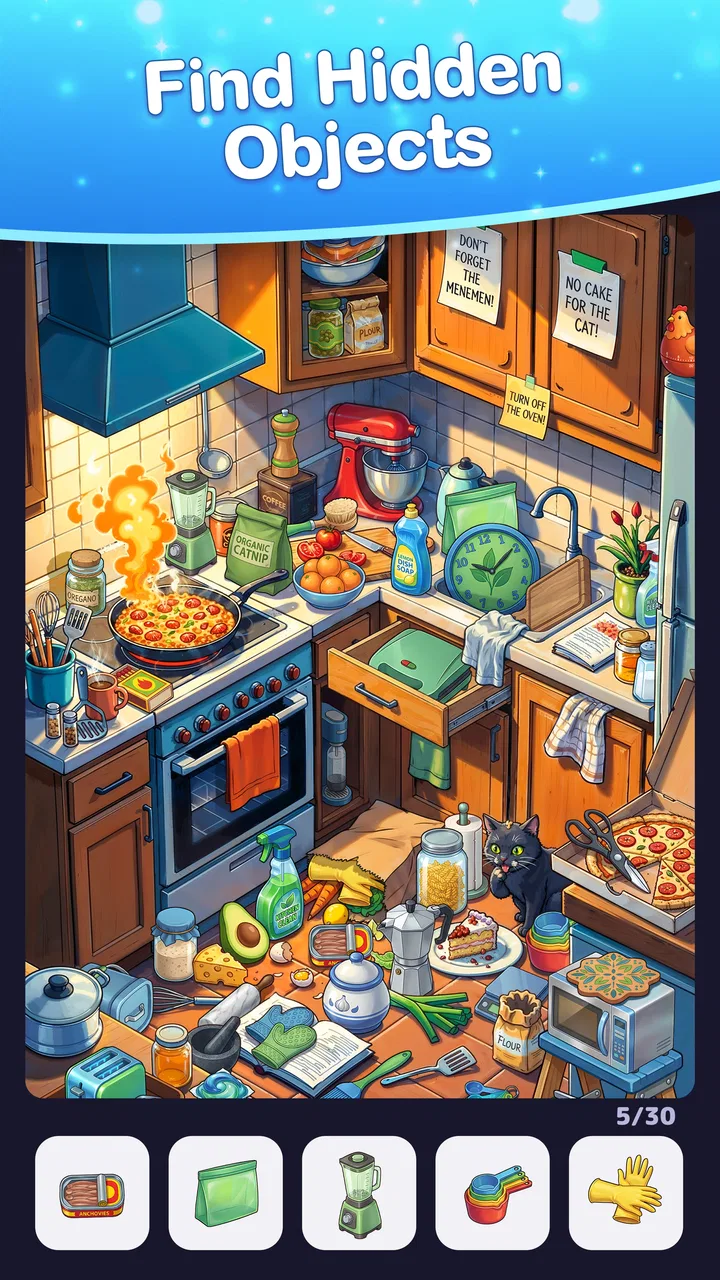
Find Hidden Objects - Spot It!
- 4.8
- Rating
- 10.00M
- Installs
- Free
- Price

 Analysis by App-foxy
I usually turn to a hidden-object game when I want something engaging without the pressure of a timer, a complicated story, or a long tutorial. Find Hidden Objects - Spot It! fits that mood well. It is a free puzzle game from Yolo Game Studios built around a simple question: can I notice the small details that disappear into a busy picture?
That simplicity is the main reason I found it easy to pick up. I do not need to learn a character system, manage resources, or remember a complicated set of rules. I look at a scene, search for the requested objects, and decide whether the experience feels relaxing or challenging depending on how carefully I approach it. The game is suitable for Everyone, runs on Android devices using at least version 7.0, and its current version is 2.70.
My recommendation depends less on whether you enjoy puzzles in general and more on what kind of puzzle you want. If you like visual searching and the satisfaction of spotting something that was hiding in plain sight, this is a strong candidate. If you need deep progression, wordplay, logic grids, or a competitive score chase, the usual alternatives may hold your attention longer.
You May Also Like

 Blood Strike: 2.5 Anniversary
Blood Strike’s Loadouts Turn Every Drop Into a Tactical Gamble
A close look at Blood Strike’s custom loadouts: how fast access to signature weapons reshapes its battle royale rhythm, rewards preparation, and narrows the gap between fights.

 Pandora - Music & Podcasts
Pandora’s Music Is Easy to Start, but Harder to Recover
Pandora’s strength is its low-effort path from a seed to a station. Its weak spot is how much confidence it asks you to place in connection, setup, and quiet recovery.

 8 Ball Pool
 Is Built on Rivalries, Rematches, and Routine
A close look at the rivalries, rematches, shared routines, and unanswered safety questions that turn a quick pool match into a persistent mobile community.

 Samsung Music
’s Quiet Strength Is Playing What You Already Own
Its reach comes less from spectacle than from dependable access to a personal library. That simplicity is both the app’s strongest retention engine and its ceiling.

 AccuWeather: Weather Radar
AccuWeather Review: A Quick, Clear Forecast for Everyday Decisions
For everyday plans, the best forecast is the one you can understand quickly. AccuWeather makes rain timing, radar, and local conditions easy to act on, with a few trade-offs.

 Hill Climb Racing
Why Hill Climb Racing Still Turns Crashes Into One More Run
A tiny car, a bumpy hill and one more upgrade: Hill Climb Racing keeps resurfacing because its simple chaos makes every near-miss feel personal.
More From Our News Desk



How I Decide Whether This Hidden-Object Game Is Worth Keeping
I judge whether a hidden-object game deserves a place on my phone by whether its core search still feels satisfying after the first few sessions, not just by the novelty of its scenes. I also pay attention to whether it fits naturally into the short breaks I actually have and whether I can stop without feeling pushed to keep going. From there, the key question is how well that appeal holds up over time.
The basic loop is easy to understand, but not completely mindless
The central activity is searching through illustrated scenes for objects that blend into their surroundings. That sounds straightforward, and it is, but the better moments come from resisting the urge to scan randomly. I found myself dividing a picture into sections, checking edges and corners first, then returning to areas with similar colors or repeated shapes.
That small change in approach makes a difference. Instead of tapping everywhere, I use a repeatable search pattern: upper left to lower right, then a second pass focused on texture and scale. This is especially useful when an object is partly concealed by the visual clutter of the scene. The game rewards observation rather than fast reflexes, so a patient player can make steady progress without needing gaming experience.
One practical tip is to pause after finding several easy items. The remaining objects are often harder to notice because I have become accustomed to the scene. Taking a short mental reset helps me stop looking for an object as an isolated icon and start looking for its outline, color, or unusual placement. That approach is more effective than repeatedly tapping the same obvious areas.
What I look for before choosing it over another puzzle
For me, the first decision point is the kind of attention the game demands. Hidden-object puzzles ask me to inspect a complete image and compare what I see with a target. Match-three games usually depend more on pattern recognition and planning several moves ahead. Sudoku and logic puzzles ask for deduction. Word games depend on vocabulary. None of these categories is automatically better; they simply fit different mental states.
This game works best when I want visual concentration without a heavy learning curve. I can play for a short break, but I can also spend longer on a scene if I enjoy searching methodically. It is less suitable when I want a puzzle with a single logical solution that I can reason out step by step. Finding an object can feel satisfying, yet the answer is based on perception rather than deduction.
I also consider how much friction I am willing to tolerate. A free game is convenient to try, but free-to-play design can affect how smoothly a session flows. The in-app purchase range is from $2.99 to $19.99 per item, so I would treat optional spending as a decision to make carefully rather than assuming every player will want it. For casual use, I would begin without buying anything and see whether the normal rhythm feels comfortable.
Why the game is approachable for different ages
The Everyone rating makes the game an accessible choice for households looking for a simple visual activity. I could imagine it working for a child who enjoys picture searches, an adult who wants a quiet break, or someone older who prefers a clear interface and familiar rules. The important point is that the challenge comes from noticing details, not from understanding complicated instructions.
That accessibility does not mean every scene will feel easy. A player with strong visual attention may move quickly through the early experience and then prefer more demanding puzzle categories. Someone who dislikes small visual differences may find the search tiring. I would also avoid treating it as a substitute for a structured educational tool; its value is in focused observation and casual entertainment, not in teaching a formal subject.
Where this game wins in everyday use
The strongest use case I found is the in-between moment: waiting for an appointment, taking a break from work, or sitting on a journey when I want more involvement than scrolling but less commitment than a full game session. I can start with a clear objective and stop once I have had enough. That makes the format more flexible than a story-driven game that expects me to remember what happened last time.
It is also a good option for people who become frustrated by losing. A missed object may slow me down, but the basic task is still understandable. I do not have to master a complicated control scheme before I can enjoy it. The challenge comes from concentration, and that makes improvement feel personal: I get better because I learn to inspect scenes more intelligently.
Another less obvious strength is that the game can encourage a useful screen break from rapid switching. When I search a picture carefully, I am doing one visual task instead of jumping between notifications, menus, and short clips. That does not make the game automatically healthy or productive, but it does give it a calmer rhythm than many mobile alternatives.
Where alternatives may fit better
I would choose a different puzzle category if I wanted stronger strategic depth. A logic game is usually a better fit when I enjoy proving why an answer must be correct. A word puzzle is preferable when I want language practice. A match-three game can be more satisfying when I want quick combinations, chain reactions, and a more immediately energetic pace.
I would also look elsewhere if my main goal were competition. Hidden-object play is naturally personal: I am trying to see what I missed, not directly outplay another person. Players who measure enjoyment through leaderboards, head-to-head matches, or highly visible performance targets may find the experience too quiet.
There is a trade-off with repetition as well. The basic action remains searching through scenes, so the game’s appeal depends on how much I enjoy that activity by itself. In a narrative adventure, new characters or plot developments can carry me forward. In a traditional brain-training collection, several puzzle types may prevent one activity from becoming familiar. Here, the visual-search format is the attraction and the limitation at the same time.
How I handle difficult scenes without making them frustrating
My most useful workflow is to identify the target object’s defining feature before searching. If it is a particular color, I scan for color first. If it has a distinctive silhouette, I ignore surface detail and search for shape. If the scene is crowded, I mentally divide it into a grid and finish one area before moving on. This prevents the common mistake of repeatedly covering the same central portion while neglecting the margins.
I also avoid zooming in mentally on one suspicious area for too long. When I have looked at the same corner several times, my brain starts filtering it out. Moving to another section and returning later often reveals the object immediately. That is not a special power-up or hidden mechanic; it is simply a better way to use attention, and it makes the game feel less like random tapping.
When playing with a child or another person, I would suggest taking turns identifying areas rather than both searching the entire screen at once. One person can inspect the top half while the other checks the bottom, then they can switch. This turns a solitary puzzle into a cooperative observation activity without needing extra rules. It also makes the experience more approachable for someone who might otherwise feel overwhelmed by a busy scene.
What may create friction during longer sessions
The same visual focus that makes a short session relaxing can become tiring when I play continuously. Searching small details requires sustained attention, and the experience is not ideal when I am already mentally exhausted. I prefer to stop when I notice myself tapping impulsively, because that usually means I am no longer enjoying the observation challenge.
There is also a personal tolerance issue around hints and optional purchases. If I am determined to complete every scene quickly, I may feel tempted to spend money rather than keep searching. The free entry point is valuable, but I would set a personal rule before playing: either take a break, search using a new method, or accept that one object can wait. That keeps the game from turning a relaxing activity into a purchase decision.
The game’s broad accessibility can be a limitation for expert puzzle fans. Players who want layered systems, complex deductions, or a campaign with substantial mechanical variety may reach its limits sooner. I would not choose it as my only puzzle game if I needed constant novelty. I would use it alongside a logic or word title, switching categories depending on whether I wanted visual relaxation or deeper reasoning.
What the popularity tells me, and what it does not
The game has an average rating of 4.9 from around 241 thousand ratings, with roughly 3.6 thousand written reviews and over 10 million installs. Those figures suggest that the straightforward hidden-object format has connected with a large audience. They also make it easier for a new player to see that this is not an obscure experiment with no established audience.
Even so, popularity cannot decide whether the visual style and pacing suit me. A highly rated casual game may still feel repetitive to someone who needs strategic variety. I read the broad response as evidence that the core activity is doing what many players expect, not as a promise that every scene will match my preferences.
Cost, switching, and the commitment involved
Because the game is free, trying it requires little commitment at the start. That is its clearest advantage over paid puzzle titles: I can test the search style during a short session instead of deciding in advance whether the full experience is worth buying. The sensible way to approach it is to judge the unpurchased experience first, then decide whether any optional item genuinely improves my use.
Switching away is equally easy if I discover that hidden-object puzzles are not for me. I do not need to rebuild a long-term strategy or abandon a complicated save system in order to try a different category. The real switching cost is attention: if I have become accustomed to visual searches, a logic or word game may initially feel slower because it asks me to think in a different way.
For someone comparing it with another hidden-object game, I would focus on the feel of the scenes and the amount of searching I enjoy rather than choosing purely by download count. If another title offers the exact atmosphere, puzzle density, or progression structure I prefer, changing games may be worthwhile. If I mainly want an accessible, free way to inspect pictures and pass a few quiet minutes, there is little reason to overcomplicate the choice.
Who should download it first
I would recommend giving it a try if you enjoy visual scavenger hunts, want a low-pressure puzzle, or need a game that can fit around an unpredictable schedule. It is particularly suitable for players who like improving their observation habits: scanning systematically, noticing outlines, and learning not to trust the first impression of a crowded image.
I would be more cautious if you need a strong story, competitive play, advanced deduction, or a large range of puzzle mechanics. In those cases, this game may work as a secondary option rather than a main game. It can provide a change of pace, but it probably will not replace a strategy puzzle or a word-based challenge for someone who wants constant intellectual variety.
My final recommendation
Find Hidden Objects - Spot It! succeeds because it understands its purpose. It gives me a direct visual task, keeps the rules approachable, and lets me decide whether to play casually or search with real concentration. Yolo Game Studios has made a puzzle experience that is easy to recommend to a friend who wants something calm and immediately understandable.
My honest qualification is that the format must already appeal to you. The game cannot solve the repetition problem for a player who does not enjoy looking through detailed scenes, and optional spending deserves a little self-control. But for a free puzzle in the hidden-object category, its large audience, Everyone rating, and simple entry point make it a sensible first choice.
My recommendation is to try it as a short-session observation game, not as an all-purpose puzzle collection. Use a section-by-section search method, take breaks when your attention drops, and compare it with logic, word, or match-three alternatives based on the kind of thinking you want that day. If spotting a nearly invisible object gives you a small burst of satisfaction, this is likely to earn a place on your phone.
FAQs for Find Hidden Objects - Spot It!
01What is Find Hidden Objects - Spot It! about?
Find Hidden Objects - Spot It! is a puzzle game that challenges players to locate hidden items within detailed scenes. It offers a variety of levels with increasing difficulty, designed to enhance observation skills and provide hours of entertainment. The game features diverse themes, ensuring a unique experience with each level.
02Is Find Hidden Objects - Spot It! suitable for all ages?
Yes, Find Hidden Objects - Spot It! is designed to be family-friendly and suitable for all ages. The gameplay is intuitive and accessible, making it ideal for children and adults alike. The varying difficulty levels ensure that both beginners and experienced players can enjoy the game without frustration.
03Does Find Hidden Objects - Spot It! require an internet connection?
No, Find Hidden Objects - Spot It! can be played offline, allowing users to enjoy the game anywhere without needing an internet connection. This feature is particularly useful for those who want to play during travel or in areas with limited connectivity.
04Are there in-app purchases in Find Hidden Objects - Spot It!?
Yes, Find Hidden Objects - Spot It! offers in-app purchases that allow players to enhance their gaming experience. These purchases might include hints, additional levels, or special items. However, the game can still be enjoyed fully without spending any money, as all main features are accessible for free.
05How can I improve my skills in Find Hidden Objects - Spot It!?
To improve your skills in Find Hidden Objects - Spot It!, it is recommended to play regularly and focus on different themes. Pay attention to patterns and common hiding spots, and try to complete levels without using hints. Practicing consistently will naturally enhance your observation and spotting skills over time.
Pros
- Engaging puzzles with vibrant graphics.
- Variety of levels keeps gameplay fresh.
- Easy to learn
- suitable for all ages.
- Offline mode available for on-the-go play.
- Regular updates with new challenges.
Cons
- Ads can be frequent and disruptive.
- Some levels may feel repetitive.
- In-app purchases can be pricey.
- Occasional performance lags on older devices.
- Limited hint system can frustrate players.

Find Hidden Objects - Spot It!
Gallery